

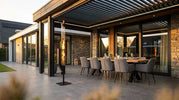
Which outdoor fireplace can you safely place under a canopy?
, 6 min reading time
, 6 min reading time
An outdoor fireplace under a canopy is completely on trend this summer. But be careful: not every fireplace is automatically suitable under a canopy.
An outdoor stove under a canopy is completely on-trend this summer: you sit comfortably outside, still sheltered, and enjoy extra cosiness and a real summer feeling. But be careful, not every stove is suitable for use under a canopy. The flue, ventilation and distance to combustible materials determine whether you can burn safely underneath. In this article you’ll read which stove is best suited for under your canopy or veranda.
A canopy extends the burning season, so you can enjoy a fire and sit outside even in the colder months. Combine your canopy or veranda with an outdoor stove, and your outdoor space becomes an extension of your living room. On long evenings the fire provides wonderful warmth and extra atmosphere. No wonder the combination of a canopy and a stove is so popular. The only question is: which stove can you safely place under it, and with what output?
Before placing a fireplace under your canopy, it’s important to know that not every type is suitable. A fireplace that produces a lot of smoke without proper extraction will trap the smoke under the roof. That smoke seeps into your clothes and furniture, leaving behind a smell that nobody wants. In addition, any type of fire requires sufficient ventilation, otherwise smoke will build up and oxygen will run low. With combustion appliances this can even lead to dangerous carbon monoxide. The main considerations are therefore the type of fireplace, the smoke extraction, fire safety and the material of your canopy or veranda.
Which stove is suitable under a canopy mainly depends on how much smoke it produces and whether it needs a flue. These are the common types of stoves for use under a canopy:
Below we zoom in on each type of fireplace and what you need to know.
A wood-burning stove is a popular choice under a canopy, because it produces a lot of heat and has a high output. Still, you can’t just place a wood stove anywhere. A wood stove under a canopy always requires a proper flue to safely vent the smoke. That pipe must extend high enough above the roof to guarantee smoke extraction and prevent smoke blowback.
For a safe installation, use a double-walled, insulated flue pipe. Such a double-walled flue stays cooler on the outside, which means you can keep a smaller distance to combustible materials and reduce the risk of fire. Wooden canopies are suitable for wood stoves, provided they are fitted with this kind of double-walled, insulated flue. Always keep sufficient distance from combustible materials and place the wood stove on a non-combustible surface.
Is a wood stove allowed under your veranda? In many cases, yes—provided you comply with the Building Decree and local fire safety regulations. Choose a wood stove with the right output for your outdoor space and be considerate of neighbours in residential areas, as smoke can cause nuisance. The correct flue height and sufficient ventilation are crucial.
Besides wood, there are other alternatives for heating under your canopy. A gas fireplace doesn’t produce smoke and can be operated at the touch of a button, but it does emit combustion gases. That’s why adequate ventilation is also important with a gas fireplace.
A bioethanol fireplace is an environmentally friendly option, as bioethanol is a biological fuel that burns cleanly and almost odourless and doesn’t require a flue. Electric fireplaces don’t produce flames or smoke and are mainly useful for ambience and a bit of extra warmth.

Do you want a real fire without the hassle of a flue? Then a low-smoke pellet outdoor fireplace is the easiest choice under a canopy. Our Ignira and Fyra run on wood pellets and use secondary combustion, in which the flue gases are burned again. As a result, the fireplace is virtually smokeless and no flue or chimney is needed.
You’ll see the same principle in the Embra, our low-smoke fire bowl. The Embra creates a beautiful, steady flame without excessive smoke. Thanks to the clever air circulation system, air is drawn in from below and burned again, allowing the fire to burn efficiently, warmly and cleanly. Some low-smoke fire pits also work on this principle.
Because these fireplaces produce so little smoke, your clothes stay fresh and your furniture doesn’t absorb a smoky smell—exactly the issue you need to watch out for under a canopy. You don’t need gas or electricity and still enjoy a real wood fire with atmosphere. Ideally choose a model that is resistant to heat and weather, because fireplaces made of steel or Corten steel will last for years under a canopy.
Whichever stove you choose, safe installation is the most important thing. Follow these guidelines to burn safely under your canopy:
Correct installation and the right clearances make the difference between carefree heating and an unsafe situation.
In the Netherlands you can often install a canopy or veranda without a permit, provided you meet certain conditions. A fireplace underneath is also allowed in many cases, as long as you burn in accordance with the Building Decree and local fire safety regulations. A low-smoke pellet outdoor fireplace or fire bowl makes this easy: without a chimney and with little smoke, you limit nuisance for yourself and your neighbours. If in doubt, always check your municipality’s rules.
Want to enjoy your canopy without worries, without a flue and without smoke smell in your clothes? Then our low-smoke stoves are the right choice. The Ignira and Fyra give you a real wood fire, and the Embra fire bowl does the same with a calm, clean flame.
Check out our low-smoke pellet outdoor stoves and choose the model with the right output for your canopy. Combine your stove with good wood pellets for the cleanest combustion. Still unsure which stove fits best? Send us a WhatsApp message or drop by, and we’ll help you decide.


